Suggest an editImprove this articleRefine the answer for “What is the TCP/IP model?”. Your changes go to moderation before they’re published.Approval requiredContentWhat you’re changing🇺🇸EN🇺🇦UAPreviewTitle (EN)Short answer (EN)The **TCP/IP model** is a practical network model that describes how devices interact on the internet and in networks using the TCP/IP protocol stack. **Key point:** it consists of four layers - Application, Transport, Internet, Network Access - and is more realistic and practical than OSI.Shown above the full answer for quick recall.Answer (EN)ImageThe **TCP/IP model** is a *practical network model* that describes how devices interact on the internet and in networks using the TCP/IP protocol stack. Short formulation for an interview: > **TCP/IP is a four-layer model that underlies the internet. It describes how data is created by an application, packaged into TCP/UDP segments, placed into IP packets, turned into frames, and transmitted over the network.** The TCP/IP model is **more realistic and practical** than OSI - it is the one actually used in modern networks. --- ## **4 layers of the TCP/IP model** The TCP/IP model consists of **four layers**, each responsible for specific tasks and protocols. --- ### **1. Application Layer** Combines OSI layers **5-7**. Functions: - network services for applications - application-layer protocols Protocols: - HTTP/HTTPS - DNS - DHCP - FTP/SFTP - SMTP/IMAP/POP3 - SSH - SNMP --- ### **2. Transport Layer** Equivalent to OSI layer 4. Functions: - delivering data between hosts - segmentation - flow control - reliability (or the lack of it) Protocols: - **TCP** - reliable transmission - **UDP** - fast, without guarantees --- ### **3. Internet Layer** Equivalent to OSI layer 3. Functions: - IP addressing - routing - path selection - IP packet fragmentation Protocols: - **IPv4 / IPv6** - **ICMP / ICMPv6** - **ARP / NDP** (sometimes classified here) - **OSPF, BGP, RIP** - routing protocols --- ### **4. Network Access Layer** Combines OSI layers **1 and 2**. Functions: - transmitting frames over the physical medium - MAC addressing - working with cables, connectors, signals Protocols and technologies: - **Ethernet** - **Wi-Fi (802.11)** - PPP - VLAN - DSL, DOCSIS - physical standards (UTP, fiber optics) --- ## **How data passes through the TCP/IP layers (encapsulation)** 1. **Application:** HTTP creates the data 2. **Transport:** TCP turns it into segments 3. **Internet:** IPv4/IPv6 packages the segments into packets 4. **Network Access:** Ethernet turns the packet into a frame 5. Frame → bits → signal → sent to the network On the receiving side, the process happens in reverse order. --- ## Comparison of the TCP/IP and OSI models  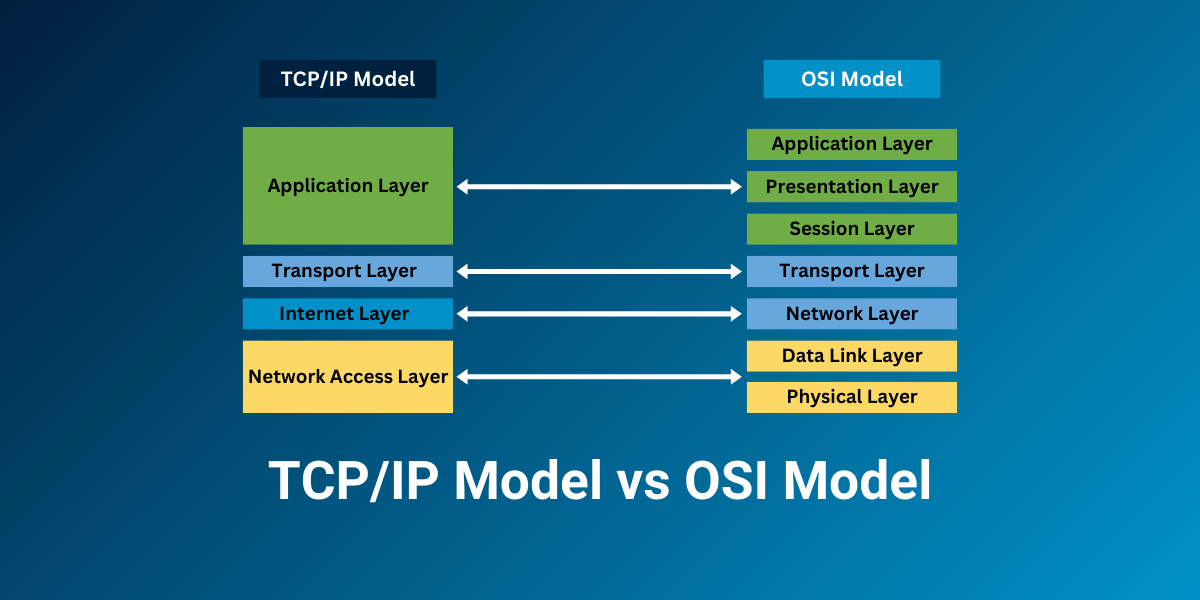  4 | OSI (7 layers) | TCP/IP (4 layers) | |---|---| | Application | Application | | Presentation | Application | | Session | Application | | Transport | Transport | | Network | Internet | | Data Link | Network Access | | Physical | Network Access | Main differences: - TCP/IP is practical → OSI is theoretical - TCP/IP has 4 layers → OSI has 7 - TCP/IP has no separate Presentation and Session layers --- ## Why TCP/IP is used Advantages: - flexibility - scalability - matches the internet's actual protocols - used in operating systems - suitable for all types of networks --- ## **Ready answer for an interview** > **The TCP/IP model is a four-layer model of network interaction that underlies the internet.** > **Layers: Application, Transport, Internet, Network Access.** > **It describes how data travels from applications to the physical medium using the TCP, UDP, IP, Ethernet, and other protocols.** > **TCP/IP is the practical model that runs the entire internet.** --- ## Cheat sheet (5 seconds) - TCP/IP = **Application, Transport, Internet, Network Access** - A practical model (unlike OSI) - Main protocols: **TCP, UDP, IP, ICMP, DNS, HTTP, Ethernet** - The TCP/IP stack forms the foundation of the network and the internetFor the reviewerNote to the moderator (optional)Visible only to the moderator. Helps review go faster.