What is the OSI model?
The OSI model (Open Systems Interconnection) is a reference seven-layer model, developed by ISO, that describes how data travels through a network from an application on one device to an application on another.
Short formulation for an interview:
OSI is a conceptual model of 7 layers that standardizes the interaction of network systems. Each layer is responsible for its part of network communication: from physical transmission to the work of applications.
OSI is NOT a protocol, but a theoretical model, on the basis of which protocols and networks are built.
The main idea of OSI
The OSI model answers the question:
How does data turn from packets into electrical signals and back?
It breaks the process of network exchange into 7 layers, where each layer:
- performs its own tasks,
- interacts with neighboring layers,
- hides its internal workings from other layers.
The 7 layers of the OSI model: a breakdown of each layer
1. Physical Layer
Transmits raw bits over the physical medium:
- electrical signals
- optical pulses
- radio waves
- connectors, cables, frequencies
Devices: cables, connectors, hubs, transceivers Example technologies: Ethernet physical layer, Wi-Fi radio, fiber optics, USB
2. Data Link Layer
Transmits frames between devices within one network (LAN).
Responsible for:
- MAC addressing
- error detection (CRC)
- media access control
Sublayers:
- MAC (Media Access Control)
- LLC (Logical Link Control)
Examples: Ethernet, Wi-Fi (802.11), PPP, VLAN (802.1Q) Devices: switch
3. Network Layer
Moves packets between networks (routing).
Functions:
- IP addressing
- routing
- packet fragmentation
Protocols:
- IPv4
- IPv6
- ICMP
- OSPF, BGP, RIP (routing)
Devices: router
4. Transport Layer
Ensures reliable or fast delivery of data between hosts.
Functions:
- port numbers
- segmentation and reassembly
- delivery control
Protocols:
- TCP: reliable, with acknowledgment
- UDP: fast, without acknowledgment
5. Session Layer
Manages sessions between applications.
Functions:
- creating/maintaining/terminating connections
- dialog control
- synchronization
Rarely used directly in modern protocols.
6. Presentation Layer
Responsible for data format:
- encoding (ASCII, UTF-8)
- compression
- encryption (SSL/TLS partially belongs here)
Example: converting data into a format suitable for transmission.
7. Application Layer
The layer where the user and applications operate.
Protocols:
- HTTP / HTTPS
- DNS
- FTP / SFTP
- SMTP / POP3 / IMAP
- DHCP
- SNMP
These are not applications, but network protocols for applications.
How data passes through the OSI layers
On the sending computer:
Application → Presentation → Session → Transport → Network → Data Link → Physical
On the receiving computer:
Physical → Data Link → Network → Transport → Session → Presentation → Application
Each layer adds or removes its own header (encapsulation / decapsulation).
Comparing OSI and TCP/IP
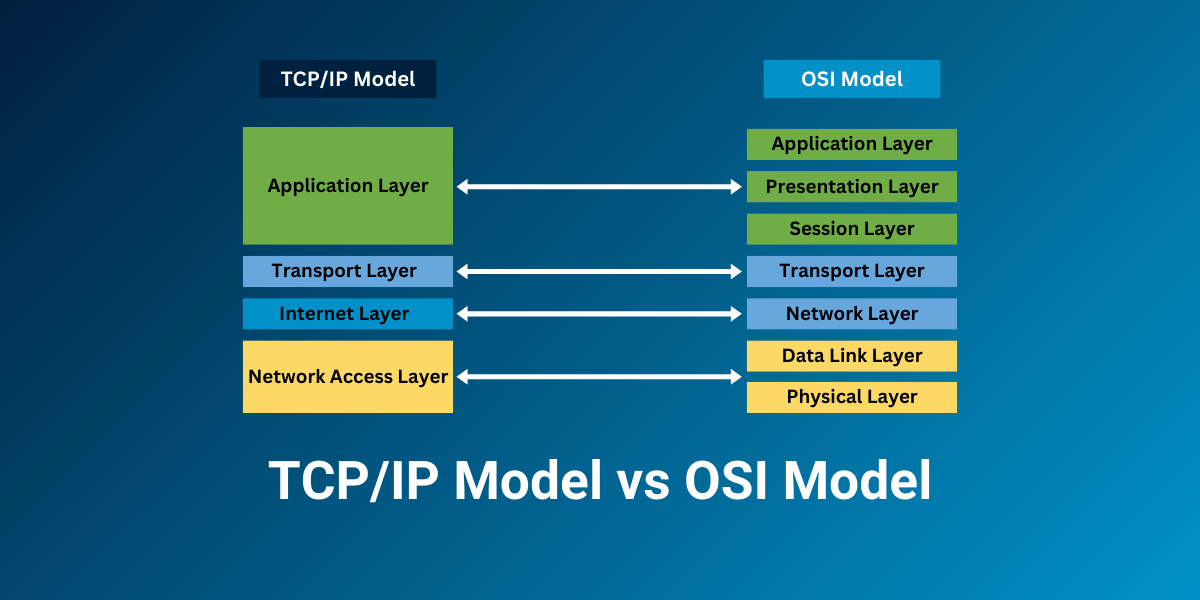

4
| OSI (7 layers) | TCP/IP (4 layers) |
|---|---|
| Application | Application |
| Presentation | Application |
| Session | Application |
| Transport | Transport |
| Network | Internet |
| Data Link | Network Access |
| Physical | Network Access |
TCP/IP is a practical model, OSI is a theoretical one.
Why the OSI model is needed
- helps understand how networks work, layer by layer
- useful for diagnostics (identify at which layer the problem is)
- applicable when designing networks
- structures the work of protocols
- used in interviews and exams (Cisco CCNA, CompTIA Network+)
A ready answer for an interview
The OSI model is a seven-layer reference model for the interaction of network systems. Each layer is responsible for its part of data transmission, from the physical medium to applications. Layers: Physical, Data Link, Network, Transport, Session, Presentation, Application. OSI helps understand network protocols, diagnostics, and network design.
Cheat sheet (5 seconds)
7 OSI layers:
- Physical: signals, cables
- Data Link: MAC, frames, switch
- Network: IP, routing
- Transport: TCP/UDP
- Session: session management
- Presentation: encryption, encoding
- Application: HTTP, DNS, SMTP
Short Answer
Interview readyA concise answer to help you respond confidently on this topic during an interview.